









Under certain conditions, the IFC allows “Fail-Safe Engineered Systems” in lieu of “emergency backup power” for safety-critical systems such as ventilation, treatment, or temperature control systems. The code states:
5004.7.2 Fail-safe engineered systems. Standby power for mechanical ventilation, treatment systems and temperature control systems shall not be required where...
Read More
Seven (7) of the Top 10 OSHA citations were in General Industry; Three (3) were in construction.
Of the Top 10 citations, ALL were issued in 2010 or earlier, dating back to 1989.
Process Safety, Flammable Liquids, and Combustible Dusts drive the top four (4) citations ($114,251,500)
The three (3) construction cases totaled $23,230,000
…
HomeRead More »
Read More
We see this all the time, although many folks think it is rare – why I am not sure, as this scenario is 100% why OSHA promulgated the Energy Control Standard in 1989, to PREVENT someone from energizing a machine/equipment while someone is performing servicing/mainteance on it. On Jan. 29, 2026, a worker was tasked with cleaning a commercial grinder. A co-worker stepped on the machine’s foot-control...
Read More
The Cybersecurity and Infrastructure Security Agency (CISA), the Federal Bureau of Investigation (FBI), the National Security Agency (NSA), the Department of Energy (DOE), the Environmental Protection Agency (EPA), the Transportation Security Administration (TSA), the Department of Transportation (DOT), and the U.S. Department of Agriculture (USDA)—hereafter referred to as “the authoring organizations”—are...
Read More
The N.C. Department of Agriculture and Consumer Services has issued a stop-sale order for the Ignik TapRack 4 Refillable Propane System. This device failed to meet several safety standards enforced by the department’s Standards Division. Manufacturers and distributors will have six months to remove these products from retail locations. Online sales shall include a note that these products are not...
Read More
I have discussed the phrase “at least” in 39 articles I have posted over the 30 years of SAFTENG’s existence. Most of my references are to process safety matters, but it is also widely used in OSH standards and codes. And still today, it is as big a “trap” as it was when I started my professional safety career in 1993. For example, two (2) of the RAGAGEPs I spend a...
Read More
Yes, having threaded rods of inconsistent lengths on a single flange is a mechanical integrity concern. While it may seem like a minor aesthetic issue, it directly impacts the ability to achieve a secure, uniform pressure boundary.
Why Inconsistent THREADED Rod/Bolt Lengths are a Problem
…
HomeRead More »
Read More
In an early post this morning, I discussed the need for “rain caps” and “weep holes” on our Pressure Safety Relief systems. And a dear friend and great ChemE reminded me that “weep Holes” are not just for draining rainwater. For example, this week I was working with an NH3 client, and I must state that NH3 gas can absolutely condense into liquid in the vent discharge...
Read More
Yes, we still need to consider drainage at the low point of our discharge piping, even with a “rain cap”. While a rain cap is designed to deflect direct vertical precipitation from entering the discharge lines/piping, it is not a hermetic seal. Over time, moisture can still enter the discharge piping through condensation, wind-driven rain, or melting frost/snow.
Looks look at ASME Section...
Read More
During a maintenance shutdown at a wood pellet plant, three workers employed by a mill machinery service company were working at the mill to clean the burner. The workers were standing at the opening of a burner door when an explosion occurred in the dryer system. The three workers were knocked backward by the force of the explosion and suffered burn injuries.
…
HomeRead More »
Read More
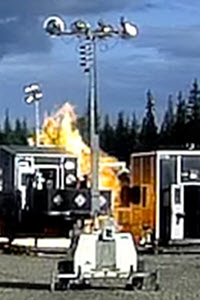
At a wellsite, two workers operating a vacuum truck were vacuuming and cleaning fluids, sludge, and sediment from a low-pressure separator vessel (LPS). Other workers opened two hatches on the LPS and inserted their vacuum hose into a debris-catch opening. Suddenly, an explosion occurred inside the LPS, resulting in a flash fire. One of the two workers was thrown against an adjoining vessel by the...
Read More
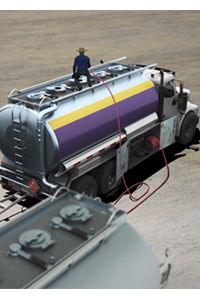
A worker was standing on top of a tanker truck to transfer gasoline from a tanker trailer to the tanker truck. The tanker truck’s engine was running, and the pumping system was engaged. The worker opened access hole covers to a compartment in the truck that held diesel and to another that was empty. Some diesel remained in the hose (mounted on a reel in a cabinet on the side of the truck) because the...
Read More