










In determining threshold quantities for toxic chemicals, OSHA used the Gaussian dispersion model. OSHA made the following assumptions:
…
HomeRead More »
Read More
I encountered something new this week; well, new to me, as I have never seen an RT Rejection rate of 26%. So I knew that was crazy high, as the normal rate is around 2-3%. So I had to go back to my ASME B31 Course and research an acceptable rate:
…
HomeRead More »
Read More
On Tuesday, April 8, 1997, at approximately 8:59 a.m., a 5,700-gallon hydrochloric acid (HCl) storage tank ruptured during filling. The failure of the HCl tank caused a significant portion of its liquid contents (which totaled about 4,800 gallons of 31% HCl) to suddenly surge over the secondary containment. The force of the liquid also caused a break in the secondary containment wall. Witnesses described...
Read More
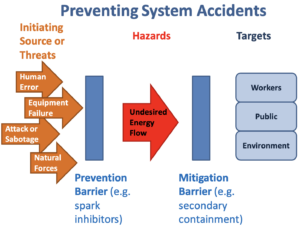
The use of risk controls or barriers to protect the people from hazards is a core principle of safety. Barriers are employed to serve two purposes:
to prevent the release of hazardous energy and to
mitigate harm in the event hazardous energy is released
Energy is defined broadly as used here and includes multiple forms, for example: Kinetic, biological, acoustical, chemical, electrical, mechanical,...
Read More
Safety Management Systems (SMS) was developed to integrate safety as part of an organization’s management of safety performance. The benefits of process-based management systems are a well-established component of quality performance. As organizations and the technologies they employ became more complex and diverse, and the rate of change in the pace of societal expectations, technical innovations,...
Read More
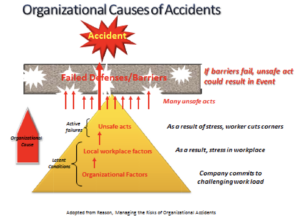
An organizational event-causal story developed by James Reason starts with the organizational factors:
Strategic decisions,
Generic organizational processes – forecasting, budgeting, allocating resources, planning, scheduling, communicating, managing, auditing, etc.
These processes are colored and shaped by the corporate culture, unspoken attitudes, and unwritten rules concerning how the organization...
Read More
This is one of the most commonly misunderstood RMP/PSM compliance issues for facilities that use rail cars as storage tanks and or use “tube trailers” as storage tanks.
EPA has been clear since 1998 on how these rail cars that are hooked up to the process and those that are “stored on spurs” are to be managed in regards to RMP threshold determination and “definition of...
Read More
Lockout Tagout
Lockout/Tagout Accidents (includes Machine Guarding)
OSHA Compliance
Permit Required Confined Spaces
A bakery company and three company directors have been fined £373,000 after two (2) workers (43 and 47) died inside a bread oven. The men were carrying out maintenance work when they became trapped inside the 70′ long conveyor oven, where temperatures were above 100°C (212°F). They died from burns and heat exposure after being unable to escape.
…
HomeRead More »
Read More
Clarifications and Interpretations of the PSM Standard
The guidance contained in this appendix is provided for compliance assistance.
This appendix contains clarifications agreed to in a settlement agreement dated April 5, 1993, between OSHA, the United Steelworkers of America, the Oil, Chemical and Atomic Workers International Union, and the Building and Construction Trades Department of the AFL-CIO....
Read More
Managing static electricity during the transfer of flammable liquids is based on the fluid’s conductivity, measured in picosiemens per meter (pS/m). High-conductivity liquids dissipate charge quickly, while low-conductivity liquids (static accumulators) hold onto the charge, creating a spark hazard.
The following table summarizes the maximum flow velocities recommended by NFPA 77 and API 2003...
Read More
A five-pound CO2 cylinder being stored in a compressed gas storage cage at a power plant failed catastrophically and became a missile. The cylinder destroyed the storage cage, then struck one of six stationary hydrogen storage cylinders used as emergency make-up for the hydrogen supply system. One of the hydrogen cylinders was broken away from its mounts and moved 10 feet from its original location....
Read More